Correspondences
A six-month programme of written reviews and one-to-one mentoring
"For the sage to imagine is to see, as for the magician to speak is to create."Éliphas Lévi
As painters, we are all alchemists. We begin with an image, fleeting and enticing, and then the painting turns out to be something else entirely. The space between the two is where the magic happens.
You don't have to be an occultist for the principles of magic to apply to your work. What you are trying to create is a correspondence: between your idea, your intention and what becomes visible, between the surface, the subject matter and how you make it. Lévi wrote that imagination without will leads only to dream images, lost reflections and wandering images. Correspondence is what gives imagination form.
Why do artists, often living precarious and stressful lives, find such deep satisfaction in their work? I think it is this: the correspondence between our greatest potential and giving it a voice.
This course is a back and forth: between you, your potential and its visual form, and between you and me, through letters, images and the questions I'll ask about what you want to make. You will go down rabbit holes. There will be failures. That's all part of refining the correspondence you're seeking, and of setting yourself a challenge just beyond your reach, the kind that holds your interest and sustains your evolution.
Marijke
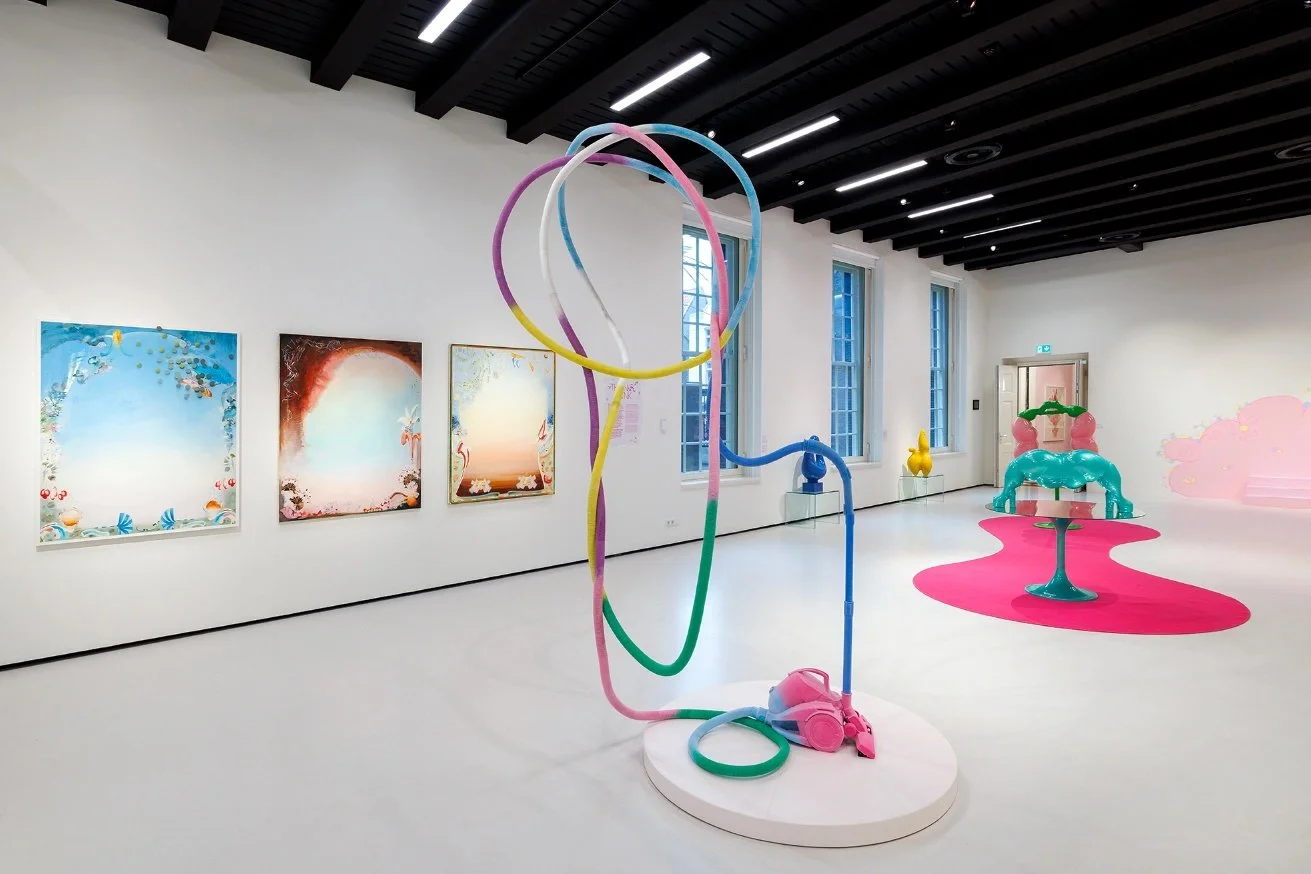
Marijke Vasey, I Hit You with a Flower, Stedelijk Museum Schiedam, 2024–25
How the six months work
One exchange a month, with time in between to paint.
A welcome conversation on Zoom. We look at the work together and set out what you'd like from the six months.
Studio correspondence. You send images of your work and a short letter about what's happening in your practice. I respond with a substantial written review.
A conversation on Zoom to talk through the review and what has happened in the studio since.
The Power of 4 is included: four minutes a day, four days a week, with a small group of artists. A light daily thread between our exchanges, there if you want it.
How I write a review
When your images and letter arrive, I look at the work first, then read what you've written. Then I go for a walk and let everything percolate.
I come back and repeat the process, and start to jot down notes. I live with the work and the ideas for a while, and only later do I write my response. It keeps growing as I build a relationship with the work, and with what you've told me you are trying to do.
In the review itself, I look closely, passage by passage: where the colour comes alive, where the marks are working against the space, what a material seems to be there for. I bring in artists and references that connect to what I see, suggest practical things to try in the studio, and ask the questions that open the work up.
It's a letter between artists: something to read slowly, come back to, and answer through the work.
At Goldsmiths I wrote up every tutorial, so the thinking didn't disappear once the conversation ended. A written review gives you the same thing: a record you can return to whenever the work needs it.
From past written reviews
"The strokes are reminiscent of writing and the actual writing on the painting functions as a kind of key or anchor."
"There is less there but it is a lot more powerful. I think you need to give us more clarity, not more content necessarily."
"Can something be new if you are reconfiguring past works? Of course it can."
"In this new work the text is more succinct and the painting is more cryptic as well so the two are more in harmony which results in the power of the work." (three months later)
Read two letters to one artist, three months apart, with the work they respond to (PDF) →
How it works with the Power of 4
In the Power of 4, you follow what interests you, what lights you up and sparks your imagination. Each time you log it, you strengthen your connection to it, so a fleeting interest becomes something you can return to and build on.
Correspondences takes this further. In writing, you set out where you want your work to go, and together we look at how the work corresponds to that intention: making visible what was invisible, and noticing how it grows and changes. It generates momentum, and it generates self-trust: you engage with the unknown, following your interests, and you're supported while you do it.
About me
I'm a painter. I studied Fine Art Painting at Wimbledon School of Art and did my MFA at Goldsmiths. In 2016–17 I took the Turps Correspondence Course myself, so I know what it means to have someone look closely at your work from a distance, and how much a written response can carry.
My work has been shown at the Stedelijk Museum Schiedam, DS Galerie in Paris, Art-o-rama in Marseille and Le 19 CRAC in Montbéliard. Alongside painting, I have twenty years' experience teaching and mentoring artists, including nine years at London College of Fashion, and I run a critique group for painters.
I've also had to rebuild my own practice after an interruption, so I know the way back is rarely a straight line.
Full CV and exhibition history →
This is for you if
- You want to develop a project or body of work in depth, with close attention from a practising painter.
- You're returning to your work after an interruption (work, family or loss of confidence) and want a serious way back.
- You're curious about the space between the image you start with and the painting you make.
- You'd like a steady rhythm: one exchange a month, with time to paint in between.
Fee
£1,500
or six monthly instalments of £250. Includes six months of the Power of 4.
I work with up to three artists at a time, so start dates are arranged individually after our conversation.
Questions
Do I need to be interested in magic?
No. Correspondence and alchemy are ways of thinking about how an intention becomes an image. The work itself is practical: your paintings, your letters and my written responses.
What if I haven't made anything in years?
Then we start with what you made before and what you'd like to make now. The first month is about finding a way in, at a pace that fits your life.
Do I need a goal, like a show or art school?
Some people have one, others simply want to take their work further. We shape the six months around what you want.
What happens in the free conversation?
We talk about your work and what you'd like from the six months, and see whether this is a good fit. There's no obligation.
Begin a correspondence
One-to-one support for artists who want to develop their work in depth, whether you're returning to it after a break or ready to take it further.
Book a free conversation →